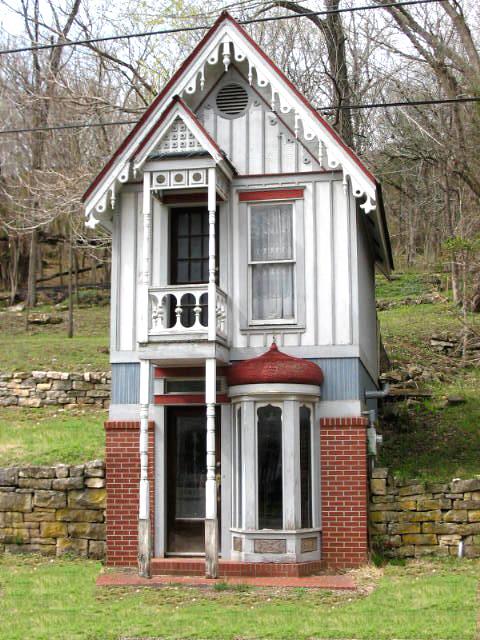
A compact residential structure — model home built to demonstrate small-footprint architectural features. Photo: Wikimedia Commons / CC BY-SA 3.0
The Distinction Between Small and Minimalist
A common misunderstanding in the public conversation about tiny homes is that minimalism is simply a consequence of having less space. In practice, the two concepts are related but distinct. Minimalism in design is a deliberate reduction of visual complexity and material variety — it is as much an aesthetic and philosophical position as a practical one. A tiny home that applies minimalist principles does so by choice; one that achieves the same square footage without those principles often feels crowded rather than calm.
The designers who have produced the most-cited Canadian examples of the form tend to treat minimalism as a starting point, not an outcome. They begin by eliminating elements rather than adding them, and they plan circulation (how a person moves through a space) before settling on room dimensions or material finishes.
Multi-Purpose Furniture and Built-In Storage
The most immediate design challenge in a small home is accommodating the functional requirements of daily life — sleeping, cooking, bathing, working, and storing belongings — in a space where each square metre is doing multiple jobs simultaneously. The standard residential approach, in which each room serves a single dedicated purpose, does not translate to a 25-square-metre floor plan.
Furniture that converts or stacks is a practical response to this constraint. Beds that fold into walls or lift to reveal storage underneath, dining tables that collapse and mount to the wall when not in use, and sofas designed to function as guest beds are all common in well-executed tiny homes. The critical factor in making this work is quality of mechanism. Furniture that converts smoothly encourages daily use; furniture with stiff or awkward mechanisms tends to remain in one configuration permanently, negating the purpose.
Built-in storage is generally preferred over freestanding furniture in small spaces, because built-ins can be fitted to the exact dimensions of a wall, floor-to-ceiling if necessary, without wasting the irregular volumes that accumulate around freestanding pieces. Under-stair storage, benches with lift-top compartments, and kitchen cabinetry that extends to the ceiling are all practical applications of this principle.
Light as a Design Material
Natural light affects the perception of space more dramatically than almost any other design variable. A room flooded with daylight tends to read as larger than it measures; a room of identical dimensions lit poorly feels compressed. Tiny home designers in Canada work consciously with window placement to maximise light penetration across all hours of the day.
South-facing glazing is standard in passive solar design, and many Canadian tiny homes prioritise a south-facing orientation for the main living area. Skylights, which bring light in from above without requiring wall area, are used in sleeping lofts and compact bathrooms where vertical space exists but horizontal wall space is limited. Clerestory windows — horizontal strips of glazing near the ceiling — allow light to enter high in a room and wash across the ceiling, brightening the space without creating glare at seated eye level.
Reflective interior surfaces — light-coloured paint, polished concrete, pale timber — amplify the effect of available light. Heavy curtains, dark finishes, and cluttered surfaces absorb light and work against the perceptual openness that makes small spaces livable over time.
Canadian Climate Considerations
Canada's climate imposes particular demands on any structure intended for year-round habitation. Thermal performance — the ability to retain heat in winter without overheating in summer — is a central design concern, and one where small structures face specific challenges and opportunities.
The challenge is air sealing. A tiny home has a high ratio of exterior surface area to interior volume. Heat loss through walls, floors, and roofs is proportionally greater per unit of floor area than in a large house, meaning the thermal envelope must be built to a higher standard to achieve equivalent performance. Well-insulated tiny homes intended for Canadian winters typically use structural insulated panels (SIPs) or dense-pack cellulose or spray foam insulation in a double-stud wall configuration, achieving insulation values significantly above the National Building Code minimums.
The opportunity is that a smaller volume is cheaper and faster to heat once it is well-insulated. Many Canadian tiny home dwellers report using a small propane or wood-pellet stove as their primary heat source, supplemented by electric baseboard or in-floor heating where utility connections permit. Heat recovery ventilators (HRVs) are standard in well-built small homes, providing continuous fresh air exchange without the heat loss that comes from simply opening windows in winter.
Materials and Finishes
Minimalist design is often associated with a narrow palette of materials — typically two or three at most — applied consistently throughout the interior. This restraint serves both aesthetic and practical purposes. Fewer material transitions mean fewer visual interruptions, which makes a small space read as more unified and spacious. Practically, simpler material schedules are easier to execute well in tight quarters where installation tolerances are more demanding than in a large build.
Common material choices in Canadian tiny homes include exposed wood (both structural timbers and finish cladding), polished concrete or hardwood flooring, white or off-white plaster or board-and-batten walls, and stainless steel or bare metal in the kitchen and bathroom. Natural materials are preferred by many builders because they age well and integrate with both rural and semi-rural Canadian settings.
Durability matters more in a small home than in a large one, because there is nowhere to move if a surface deteriorates. Materials in a tiny home take more daily contact per square metre than equivalent finishes in a house with spare rooms and corridors. Solid wood rather than veneer, porcelain tile rather than vinyl, and metal hardware rather than plastic are the kinds of small upgrades that affect the long-term feel of the space considerably.
Outdoor Space as an Extension of the Interior
The relationship between the interior of a small home and the land around it is often a functional one, not merely an aesthetic preference. A well-designed covered deck or porch effectively extends the usable living area in warm months, providing space for dining, working, and socialising that the interior cannot accommodate. In Canadian climates, a south-facing covered outdoor area extends the usable season considerably — a structure with adequate rain protection and orientation can be used comfortably from spring through autumn in most parts of the country.
Landscape design immediately around a tiny home also shapes the experience of daily life. A few mature trees or tall planted screens provide visual privacy without the cost of additional built structure, and planted boundaries can reduce wind exposure, which affects both comfort and heating costs in exposed rural sites.
What the Best Examples Have in Common
The tiny home designs that receive sustained attention from architectural publications and housing researchers share several qualities. They are specific — designed for a climate, a site, and a household type rather than as generic small structures. They are honest in their materials, using durable and tactile surfaces rather than finishes that mimic something more expensive. And they treat the constraints of the brief as design parameters rather than limitations, finding solutions in the compression of space rather than trying to replicate the spatial experience of a larger house at a smaller scale.
The minimalist housing movement in Canada draws from a broader international tradition of small-scale residential design, including the Japanese concept of ma (negative space as a design element), Scandinavian approaches to compact, high-performance housing, and the North American tradition of owner-built vernacular structures. What distinguishes the current moment is that these references are increasingly available to designers and builders who are not trained architects, and that the demand for small, well-designed homes has never been more clearly articulated by the households looking to occupy them.